
How To Choose The Best DMARC Report Analyzer For Your Business In 2026
Last Updated on October 25, 2026 by chada sravas
Why DMARC Report Analysis Matters for Email Security and Deliverability in 2026
In 2026, the email environment is becoming more vulnerable to advanced threats like phishing, domain spoofing, and business email compromise. To safeguard email communication, adopting DMARC (Domain-based Message Authentication, Reporting and Conformance) remains a worldwide essential practice. However, DMARC’s success is reliant on the regular evaluation of aggregate reports delivered through DMARC XML files. These XML reports provide crucial aggregated information on authentication success rates and any suspicious activities targeting your domains.
The necessity for an effective DMARC report analyzer is greater than ever. By converting raw DMARC XML data into understandable reports, organizations can quickly pinpoint authentication problems, incorrect configurations, and fraudulent email sources. A robust XML parser combined with a converter that transforms XML into human-readable formats offers teams real-time insights into authentication issues, helping them protect their brand, customers, and stakeholders from dynamic threats. For sectors like financial services, government, healthcare, and technology, where email security is critical, precise DMARC report analysis reinforces compliance, improves email deliverability, and supports effective DMARC management activities.
Key Features to Look For in a DMARC Report Analyzer
Choosing the appropriate DMARC report analyzer demands careful consideration of its functionality, user-friendliness, and analytical depth. Here are key features to focus on:
1. Comprehensive Parsing and Conversion Capabilities
A contemporary DMARC report analysis tool needs to effectively manage substantial amounts of incoming DMARC aggregate reports and correctly interpret DMARC XML reports from various sources, including Google, Yahoo, Gmail, and Amazon. It should employ a dependable XML parser to retrieve information such as IP address, message counts, domain insights, and authentication outcomes for both SPF and DKIM checks.
Human-Readable Output
Seek out a sophisticated XML-to-human converter that can convert unprocessed XML data into user-friendly, insightful dashboards. Reports that are easy to read allow all parties involved — such as CISOs, security administrators, and non-technical personnel — to understand the findings, speed up DMARC onboarding, and streamline the transition through DMARC phases, from monitoring to quarantine or rejection.
2. Detailed Email Authentication Insights
The analyzer must effectively communicate the results of DMARC compliance by emphasizing authentication rates, failed authentications, incorrect DMARC settings, and any unauthorized email sources. Tools such as DMARC Inspector and DMARC Management Platform are particularly good at visualizing the status of email protection and delivering domain audit findings.
3. Threat and Policy Alerts
Advanced DMARC report analysis tools ought to offer customizable threat notifications through a centralized alert system, indicating emerging threats like unauthorized senders, attempts at mass spoofing, or sudden increases in activity from unauthorized IP addresses. Automated alerts are particularly beneficial for DMARC implementation in global businesses operating in areas such as Asia-Pacific, Europe, and the Middle East & Africa.
4. Support for Related Authentication Standards and Tools
DMARC operates on the foundations of SPF and DKIM, making it essential to integrate with tools such as SPF Surveyor, DKIM Inspector, and DKIM Validator for comprehensive email authentication. Robust platforms provide features like an integrated DMARC record generator, validation of published DMARC records, and BIMI tools to boost brand prominence.
5. Granular Aggregated Data and Analytics
A top DMARC report analysis tool consolidates information from various domains and subdomains, offering comprehensive insights into domain summaries, authentication success rates, primary report sources, and IP address distributions. It includes functionalities such as domain assessments, a DMARC glossary, and instructional resources that provide continual technical support for compliance, DMARC management, and policy adjustments.
Comparing Ease of Use, Reporting Accuracy, and Automation
Choosing the appropriate solution requires finding equilibrium between user satisfaction, technical precision, and the ability to automate processes.
Intuitive User Experience
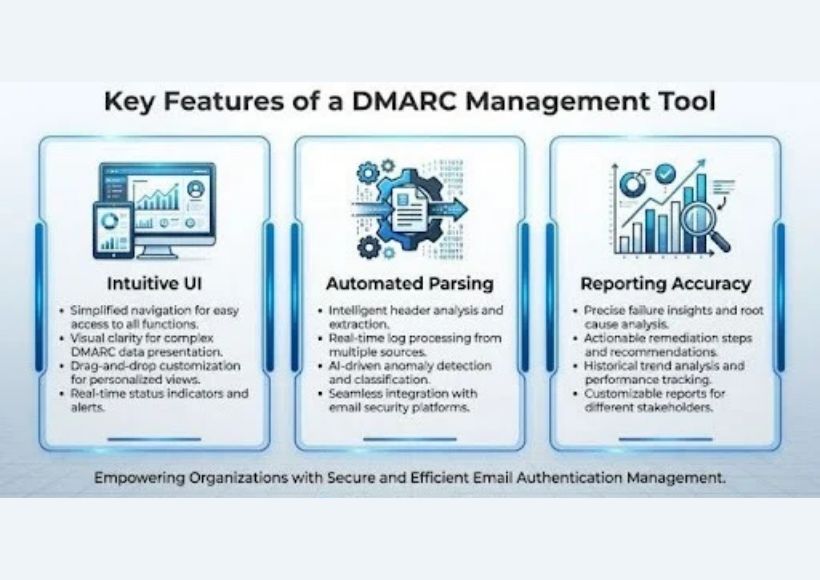
A DMARC management tool needs to provide a user-friendly dashboard, straightforward navigation for retrieving DMARC XML reports, and comprehensive step-by-step guides to help users initiate their DMARC setup. The onboarding process must be seamless, ensuring that organizations — be they NGOs, utility companies, educational institutions, or nonprofits — experience minimal delays in realizing value.
Automated Report Collection and Parsing
Look for tools that can automatically collect and interpret DMARC aggregate reports from various DMARC data providers. Features such as an automated XML parser and a converter that transforms XML into a more understandable format minimize the need for manual review and speed up the identification of non-compliant data streams or issues with DMARC record setups.
Reporting Accuracy
It’s essential to convert DMARC XML reports into clear domain summaries and authentication rate overviews. The analysis tool needs to consistently detect authentication problems and generate reports that are easy to export and understand, suitable for compliance audits and presentations to executive-level stakeholders.
Case in Point
Services like dmarcian and MXToolbox set high standards for automation and accuracy. A DMARC management platform combines automated workflows with tools such as Email Header Analyzer and Alert Central to detect email authentication issues quickly. You can also use a free DMARC analyzer to review DMARC records, identify configuration errors, monitor authentication failures, and access technical guidance to improve email security and compliance.
Evaluating Scalability, Integrations, Compliance, and Support
Assessing Scalability
Scalability is crucial for companies operating in multiple sectors, growing internationally, or encountering fluctuating message volumes. The DMARC report analyzer needs to efficiently process thousands of DMARC XML reports each day without loss of performance. Key features such as domain clustering, consolidated data perspectives, and integrated DMARC onboarding for different divisions are necessary for global organizations, particularly in fields like finance, government, and technology services.
Critical Integrations
Ensure that the platform connects effectively with essential business systems, SIEM applications, and ticketing software. A smooth connection to email gateways, cloud services (such as Amazon), and widely-used security frameworks amplifies the effectiveness of your DMARC information. Check for alignment with DMARC Domain Checker, DMARC Record Wizard, DMARC Services, and public policy tools.
Compliance Support and Technical Guidance
Make sure that the analyzer is equipped for DMARC implementation in accordance with international DMARC regulations and specific industry standards. Essential features include domain auditing capabilities, validation of published DMARC records, comprehensive compliance dashboards, and immediate DMARC consultations. Top providers deliver technical assistance, domain insights, and DMARC support customized to the requirements of various sectors, including healthcare, government, and technology.
Vendor Support and Training Resources
Robust DMARC assistance, including training, consultations, and domain auditing, is crucial, particularly when navigating DMARC progressions or addressing zero-day email vulnerabilities. Choose providers that offer educational resources, practical guides, and support across multiple regions, facilitating flexibility for organizations in the Asia-Pacific, Europe, the Middle East and Africa, and the Americas.
How to Match Pricing and Vendor Fit to Your Business Needs
Flexible Pricing Models
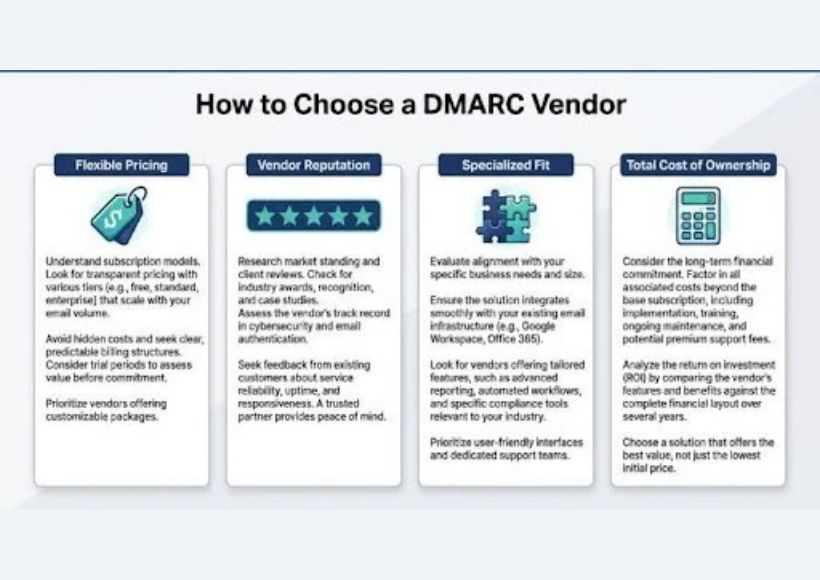
DMARC report analysis tools come with various pricing models, which may be based on the number of domains, message volume, individual users, or enterprise-wide subscriptions. It’s important to choose a model that matches your organization’s size, number of domains, and expected message traffic. Smaller businesses might find free options adequate, whereas larger companies that need comprehensive DMARC services and assistance could benefit from tailored enterprise solutions.
Vendor Capabilities and Reputation
Consider seeking out reputable companies like dmarcian, MXToolbox, DMARC Services, and DMARC Management Platform, which are recognized for their dependability, customer support, and international reach. Evaluate how responsive these vendors are, the technical assistance they provide, and their experience with organizations in sectors like nonprofits, utilities, or tech services that mirror your own.
Fit for Specialized Requirements
If your industry requires sophisticated functionalities like domain auditing, BIMI Tools for visual verification, or adherence to international DMARC standards, make sure the solution is equipped to address these requirements. For businesses in regulated fields such as finance, government, or healthcare, it’s essential to choose platforms that offer comprehensive compliance documentation and effective domain auditing features.
Evaluating Total Cost of Ownership
Take into account the overall expenses, which include training, DMARC onboarding, consultations, continued support, access to DMARC reference materials, and options for future enhancements. Opting for a provider that offers clear pricing and a clear plan for technological improvements guarantees that your investment will enhance long-term email security and DMARC adherence.
By prioritizing a wide array of features, automation, scalability, precise reporting, and competitive options from vendors, organizations can confidently choose the most effective DMARC report analyzer to protect email authentication and maintain compliance amid the changing threat landscape of 2026.
Also Read : How To Create a Cybersecurity Budget For Your Small Business
