
Exporting Business Data for AI? Build a File Manifest First
Last Updated on October 24, 2026 by chada sravas
A one-page inventory catches the scope gaps, rights questions and stray files that a bulk export carries out the door.
Picture a Friday afternoon. Someone from the business side pings IT: “Can you export the support archive for that AI data conversation? Just send everything.” The folder is right there. The files open. The export would take twenty minutes.
That twenty minutes is where things go wrong. A folder that opens cleanly tells you nothing about whether its contents belong in a dataset, who approved them, or what’s hiding three subfolders down.
THE SHORT VERSION
- Build a metadata-only manifest before any export: scope, sources, versions, owners and open questions.
- Name the business approver separately from the technical owner who runs the export.
- Before transfer, check the delivery matches the approved manifest, not just that the files arrived intact.
What is a file manifest, and why build it first?
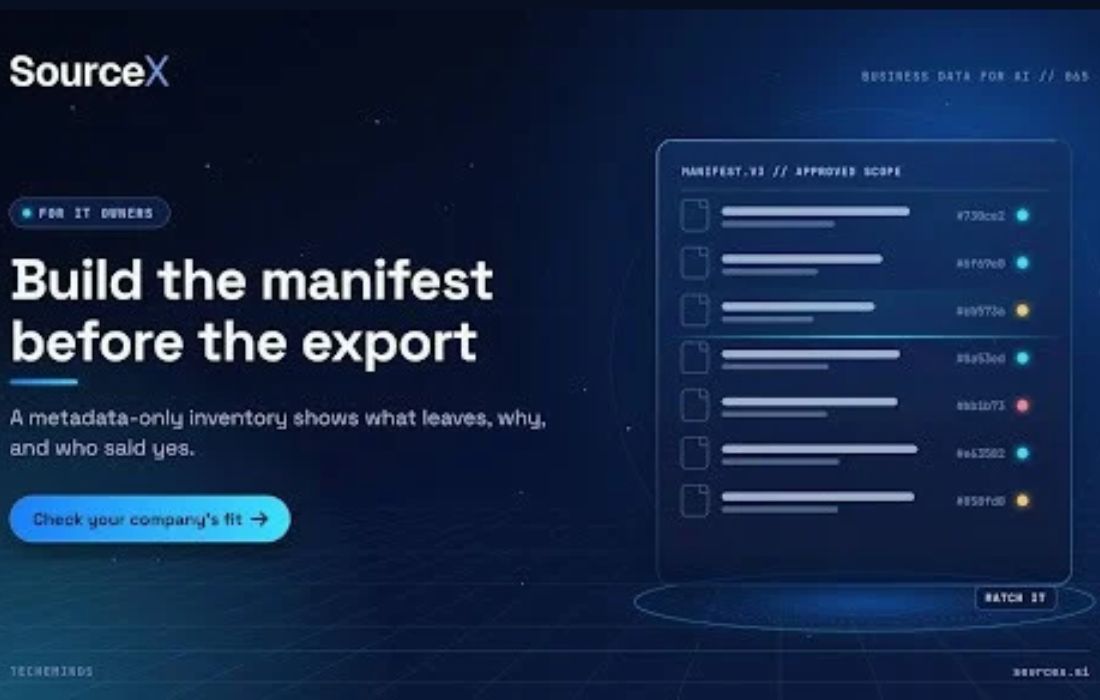
A manifest is a structured record of what the company intends to include, where each item came from and which version was approved. Think of it as a packing list written before you pack.
Building it before extraction matters because the records are still sitting inside your normal environment, with your normal controls. Every gap you find now costs a conversation. Every gap you find after the export costs a cleanup.
Write the scope before anyone touches the data
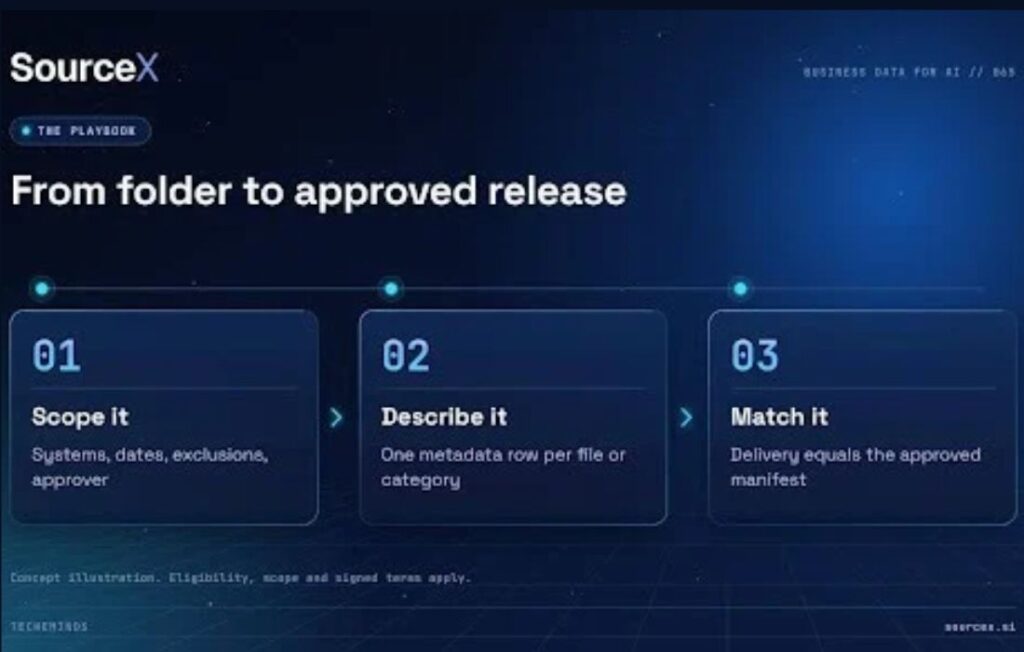
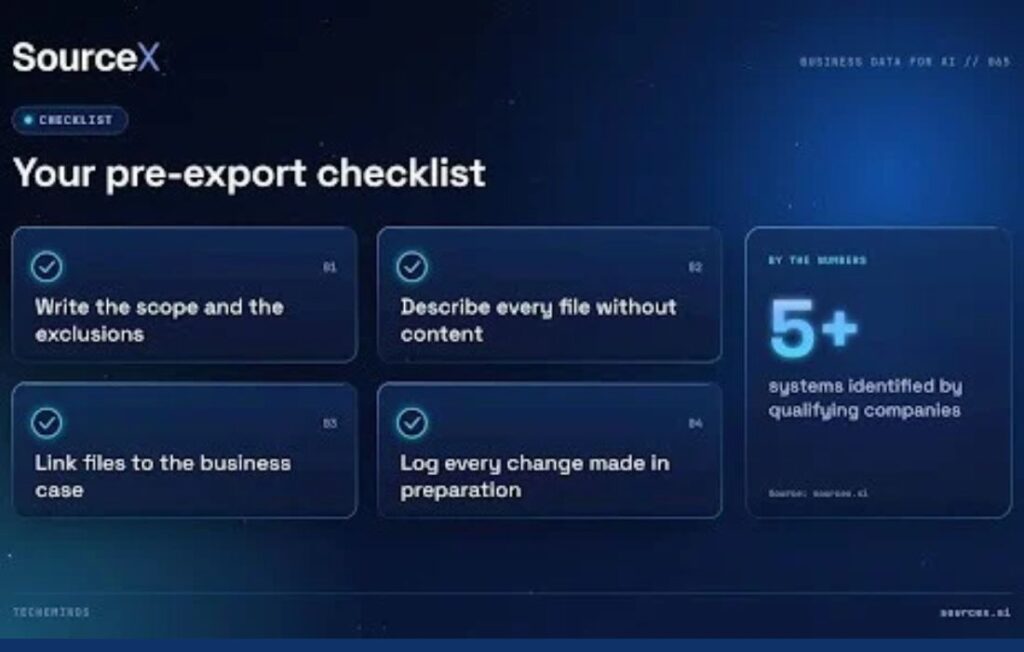
Start with three plain statements: which systems, which categories of records, and which date range. Then write the part people skip, the explicit exclusions. Particular attachment types. A business unit with unresolved contract terms. Anything still under legal hold.
Ban the phrase “export everything.” A full backup and a purpose-built dataset do different jobs, and confusing the two is how a narrow pilot becomes a sprawling transfer.
Finally, name two people. The authorized business approver, who can decide whether the company licenses anything. And the workflow owner, who understands what the records mean. Your admin can produce the export, but export access is not licensing authority. Export access does not establish the authority to license company records.
Give every file a useful description, without the content
A practical manifest row can capture:
- A file or category identifier and its source system
- Date range, approximate count and format
- Preparation status and the responsible owner
- Open questions, in plain words
Keep it at the metadata level. The point is to make the collection understandable without creating yet another copy of sensitive records.
Explain your numbers, too. A system count can include duplicates, deleted items or automated events that don’t represent distinct business cases. “About 40,000 tickets, of which an unknown share are auto-closed spam” is far more useful than a confident round number.
Connect the files to the business case
A reviewer needs to know what the collection shows. Does it link a customer request to an action and an outcome? Does it preserve the policy version needed to interpret a decision?
Here’s an illustrative example. A support export includes every ticket but not the refund approvals, which live in the finance system. On paper the dataset looks complete. In practice, the decisions that depended on those approvals are unexplained. Record that dependency in the manifest instead of hoping nobody notices.
Ask the workflow owner to review the manifest. They can identify dependencies an outsider would miss.
Log every change, then match delivery to approval
The delivered artifact may strip attachments or transform identifying fields. Log each change and the version of the process used.
Be clear about the limits. Removing direct identifiers does not guarantee that the remaining context can’t identify someone; a rare event or a chain of linked details can still be revealing. And a file’s presence in company storage doesn’t establish the right to license its contents for AI training or evaluation. Rights and confidentiality get their own review.
Before transfer, compare what you’re about to send against the approved manifest, line by line. Integrity checks such as file hashes can show whether an artifact changed. They can’t show that its content is correct or lawfully licensed.
Check the access boundary as well. Temporary review access shouldn’t accidentally expose earlier, unprepared versions sitting in the same bucket.
Where licensing fits in
If the manifest is in service of a licensing conversation, it also makes that conversation faster and calmer. SourceX licenses approved business data directly from companies for AI training and evaluation. You sign with SourceX, not an AI lab, and SourceX manages the agreement, preparation and payout under signed terms.
It is best suited to companies with 50+ full-time staff at peak and several years of operating history, and qualifying companies identify at least five systems. SourceX advertises payouts of up to $4 million, an upper bound reserved for the largest enterprise datasets rather than a typical or guaranteed payout.
The initial fit check asks a few questions about the company. No uploads, no customer or employee records, and nothing is delivered until you sign.
What should the IT owner do before the next export request?
Start with the next workflow someone asks you to export. Build a metadata-only manifest for it and flag every unresolved question in its own column. Then hand it to the business approver.
You’ll give the company something concrete to decide on, and no export becomes a transfer nobody fully defined. The export may still take twenty minutes. Now the team knows what was approved and what needs to stay out.
If your company wants to explore licensing, use SourceX to check company fit before exporting any records. Start with the manifest, not the files.
About the founder
Noah Loul is a four-time founder and the founder and CEO of SourceX, which licenses business data directly from companies for AI training and evaluation. He previously founded B2B Rocket, acquired by Blackpearl Group. His work focuses on building permission-based data infrastructure for AI.
Also Read : What Is a Data Repository? Key Benefits, Management, And Security Practices
