
How to Collaborate With Influencers: 6 Steps For Brands
Last Updated on August 26, 2026 by chada sravas
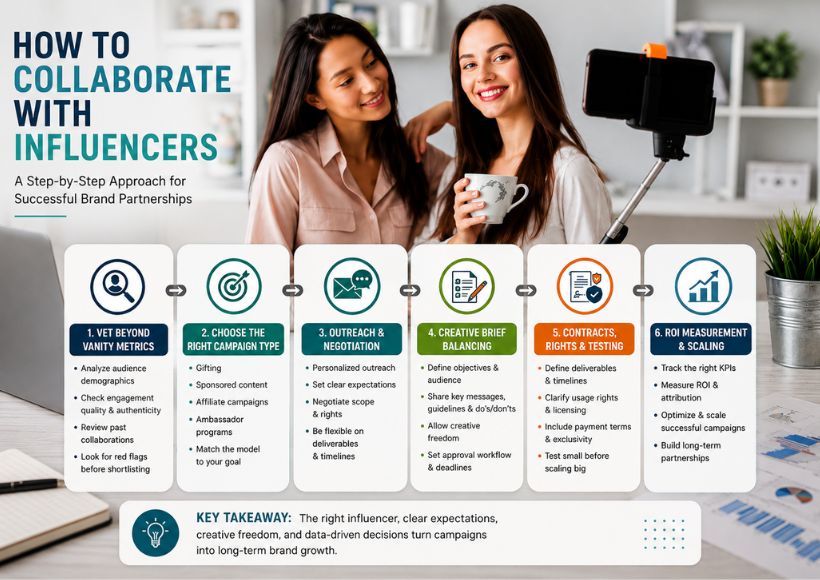
Influencer campaigns tend not to fail due to the creator’s failure to create content. More often, issues are identified prior to filming (wrong audience, unclear expectations, too narrow a brief, incomplete commercial terms, the brand measuring likes rather than business results). A solid collaboration procedure connects the selection process, negotiation, content creation, measuring, and retention throughout.
Step 1: Vet Beyond Vanity Metrics
Begin assessing if the influencer actually connects with the audience that is required for your business. Although follower count can be a good starting point, it’s not the only thing to pay attention to. Understanding how to find the right influencer for your brand also means looking at audience demographics, interests, language, age groups, and available audience insights.
An influencer who owns 30,000 followers from the relevant market segment might be much better for your localized project than the one who has 300,000 followers from all over the world in countries where the product hasn’t been launched yet.
Engagement also needs a deeper audit. Don’t judge a creator from the percentage shown on a media kit alone. Read comments on several recent posts. Genuine questions, product discussions, personal experiences, and conversations between followers indicate a more active community than hundreds of identical emoji comments. Compare views across multiple posts and videos. A single viral post should not become the basis for your campaign forecast.
Before shortlisting a creator, check for:
- Sudden unexplained follower or view spikes.
- Large audience segments outside your target geography.
- Repeated generic or suspicious-looking comments.
- Major engagement or view drops on normal posts.
- Excessive sponsorships or frequent promotions of unrelated products.
Earlier collaborations are important as well. Practically, the creator may be able to achieve an impressive reach due to working with various sponsors, yet if they are promoting the same products too often, their audience may lose trust. It is important to analyze whether or not the creator’s usual content and other advertising campaigns fit into the brand of your product.
Step 2: Choose the Right Campaign Type
The collaboration model should follow the business objective. A brand looking for product discovery does not necessarily need the same structure as one trying to generate measurable sales. Gifting can help test product fit and introduce creators to a product, while sponsored content provides more predictable deliverables. Affiliate campaigns put greater emphasis on conversions, and ambassador programs are better suited to creators who have already demonstrated consistent value.
| Campaign Type | Cost Structure | Primary Goal | Risk Level |
| Gifting | Product or sample cost | Product discovery and testing | Medium |
| Sponsored Posts | Fixed fee or negotiated package | Awareness, reach and content | Medium |
| Affiliate | Commission per sale or lead | Direct conversions | Low–Medium |
| Ambassador | Ongoing fee, commission or hybrid | Long-term growth | Medium |
These models can also work as stages rather than isolated choices. A brand might initially gift products to relevant creators, identify those who produce strong content and audience response, and then move the best performers into paid or affiliate campaigns.
Step 3: High-Response Outreach & Negotiation
Choosing the most effective outreach medium always varies among content creators. Email is traditionally the best way to go for formal commercial proposal requests, while contacting small creators via DMs can be more effective in cases where their profiles encourage them to receive partnership proposals. The messaging needs to clarify the offer in a straightforward manner that does not require the creator to communicate back and forth several times before getting to the point.
The initial pitch needs to give a short overview of the brand, the significance of the creator, the nature of the collaboration being pitched, and what will happen next. Make sure to include relevant links to more information about the brand or the campaign. If the creator has a public business email, include it directly in the pitch instead of sending a random message.
Be flexible during budget talks. A creator may request ₹80,000 for three videos for Instagram and YouTube, but if you have a ₹50,000 budget approved, you can’t just say, “lower your rate.” Rather, discuss the extent of the project. Is it possible to do it with only one video instead of three? Will it work on a single platform? What if you reduce the term of paid advertising rights from six months to only one month?
The approach safeguards the perceived worth of the creator without limiting the brand’s ability to manage costs effectively. An identical principle can be used when the creator’s rate card exceeds expectations: change any aspect of the output, platforms, licenses, exclusivity, etc., prior to attempting to impose a standard discount.
Step 4: The Creative Brief Balancing Act
While the campaign brief has to set certain limits, it should not make the author follow a script. Marketers prefer to approve the product claims, the legal information that should be provided, content that cannot be published, deadlines, and other important aspects of brand safety. The creators should be given space to deliver the message in the style that the audience appreciates.
For instance, an application related to financial matters would need a content producer to highlight a feature that is mentioned above, add a disclaimer, apply a linking tool to monitor the actions of a viewer, as well as refrain from unsupported money-related statements. Nevertheless, it does not mean that the company will have to write each sentence in a video. The content producer knows the language of their target audience better than the manager of the campaign.
Every brief should state:
- Campaign objective and target audience.
- Platforms, formats, deliverables, and publishing dates.
- Mandatory claims, tags, links, CTAs, and sponsorship disclosures.
- Brand-safety and competitor restrictions.
- Approval process, deadlines, and revision limits.
- Content ownership and usage rights.
The clearer these boundaries are at the beginning, the less likely the campaign is to encounter expensive revisions later.
Step 5: Contracts, Usage Rights & Testing
The creator’s posting fee is not enough for the complete commercial agreement. The contract needs to cover payment schedule, cancellation policy, deliverables of the project, modifications, exclusivity, requirements regarding the disclosure of information, ownership of the content, and licensing.
The rights of usage have paramount importance. Paying ₹40,000 for an Instagram video does not mean that a brand can use the video in any advertising and marketing activities; the brand may not even be allowed to run the video on its website and modify it for the needs of other campaigns.
When a brand decides to use creator content as commercial promotion, it needs to indicate the channels and time period. For instance, the length of a 30-day paid social license is very different than the length of perpetual global rights. Such differences need to be clearly stated in the contract.
For new creators, use a test-small-before-scaling approach. Instead of committing a large budget to one unproven partnership, run a controlled campaign with several relevant creators or limited deliverables. Compare audience response, traffic, conversions, content quality, and cost efficiency. Then increase investment in the partnerships that demonstrate evidence of performance.
Step 6: ROI Measurement & Scaling Systems
The measurement method must be aligned with the campaign’s goal. For campaigns aimed at raising brand awareness, metrics like reach, video views, completion rate, branded searches, and audience sentiment need to be used. Traffic campaigns need only track metrics like number of link clicks and behavior on the landing pages. For campaigns focused on conversions, conversion goals must be tracked, including number of leads, purchases, revenue, conversion rates, and cost per lead generation.
Use multiple attribution methods where possible. Unique URLs, promotional codes, affiliate links, platform analytics, and first-party conversion data can work together to provide a more realistic picture than likes or comments alone.
When revenue can be reliably attributed, a basic ROI calculation is:
ROI = (Revenue Generated − Campaign Cost) ÷ Campaign Cost × 100
Avoid automatically opting for the creator that has the most reach. A creator that has 20,000 good views and consistent sales might be more valuable than one that has 500,000 views and almost no measurable actions.
Retaining customers or audience members is the last step. When a creator consistently delivers good content with relevant traffic, a real response from the audience, and measurable business outcomes, one should avoid running single campaigns and move toward successful influencer partnerships and more permanent solutions.
The use of recurring sponsored materials, affiliate incentives, product launches, or ambassador campaigns can make a successful experiment a permanent acquisition method for a stable audience.
The aim, however, is not to identify the creator with the largest following but to create a mechanism that selects the creator that matches the product as well as logistical terms, grants them enough creative liberty, gauges results fairly, and replicates the partnerships that have proven successful.
