
Jira Cloud vs Data Center Cost: Total Cost of Ownership
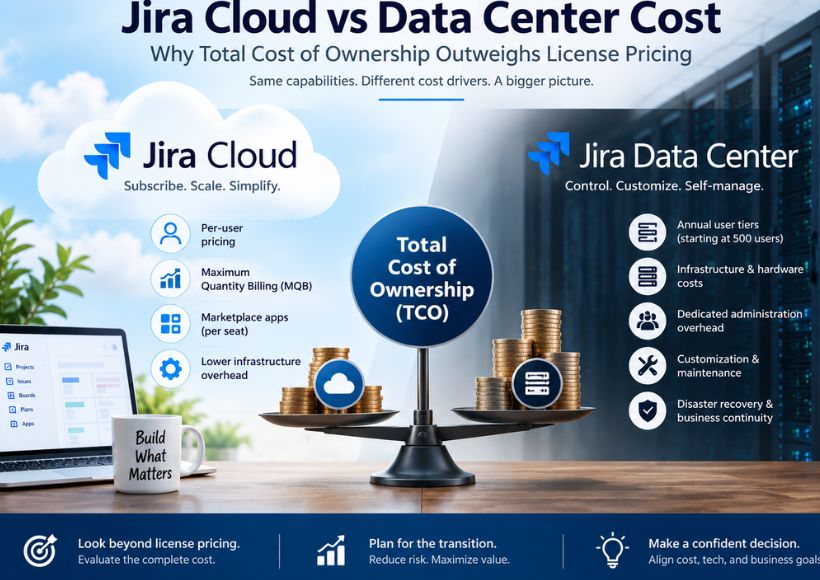
It may seem fairly easy to compare the quote for a Jira Cloud subscription with the invoice for the renewal of a Jira Data Center license, but this may result in distorted conclusions. These two deployment models shift expenses into different components of the cost structure of IT. Cloud converts most of the responsibility for infrastructure costs into recurring subscription and licensing charges, while Data Center puts most of the burden on the client for hosting, maintenance, resilience, and administration. Therefore, the comparison cannot be made only between licenses. The optimal measure for a business here is TCO, which stands for total cost of ownership, meaning the total costs of the software, infrastructure, human resources, applications, migration, operation, and governance.
Licensing Models in Transition
Jira Cloud employs a pricing system based on consumption. The monthly pricing option employs progressive pricing by using Maximum Quantity Billing (MQB), a pricing method that calculates the cost based on the maximum number of users connected during the billing period. This means that even if a business removes users mid-month, it does not lower the overall cost of the subscription. The annual subscription offers pricing based on user groups instead. This means that it can become clear that user governance is a cost management function rather than functionality in general. When considering costs, it is better to enhance user governance from the very start of the billing cycle instead of waiting until the end of the month to close dormant accounts.
Jira Software Data Center licensing is available on an annual tier-based licensing system and requires a minimum of 500 users. In contrast to the pricing structure for Cloud, organizations pay for a set number of users instead of monthly fees based on consumption. Companies want to see what licensing costs are currently but also think of it in relation to Atlassian’s new transition schedule.
Companies evaluating current licensing costs should also consider Atlassian’s announced transition schedule. For a detailed breakdown of the Data Center end-of-life timeline, licensing deadlines, and migration implications, see our [Jira Data Center End of Life guide.]
The Absorbed Costs of On-Premises Infrastructure
One of the most frequent errors when calculating total cost of ownership is considering the subscription of the data center as the entire cost of ownership. Data center services use a self-managed deployment model, which means that the organization is still responsible for the infrastructure that supports Jira.
This operational responsibility may encompass either virtual machine or physical server capacity, storage administration, OS maintenance, monitoring, backup facility, disaster recovery systems, patch testing, capacity planning, and the engineering efforts needed to keep highly available clusters operational. The financial impact tends to be shared across the budgets of infrastructure, database, security, and operations rather than being displayed on the Jira invoice itself.
The relevance of this information is especially crucial for companies that keep non-production environments for the testing and upgrading of their products. Dedicated storage and computing facilities may support the production Jira environment, whereas separate disaster recovery or staging facilities may remain unused for a long time without providing any value. The labor costs for internal DBA and systems administration are real even when they are not included in the Jira cost center.
Consequently, a Data Center business case should calculate the fully loaded operating cost, rather than treating infrastructure as “already owned” and therefore free.
The Hidden Variables in Jira Cloud Subscriptions
While the use of the cloud means that much of the burden of infrastructure management is lifted, it can also bring with it new ongoing costs that will need to be taken into account. The use of Marketplace apps provides one such example: according to Atlassian information, the pricing for Jira Marketplace apps is usually based on the number of main users of the Jira software, meaning that an organization can’t expect the price to correspond only with the actual number of users involved in a particular project.
User governance is a method of managing financial control. By signing in through MQB with monthly Cloud subscriptions, any temporary increase in seats may lead to billing, even if the user gets removed later. Therefore, organizations may find themselves facing unnecessary subscription expenditures, as dormant employees, contractors, service accounts, and inefficient security management can increase licensing requirements.
Jira Cloud vs Data Center: Comprehensive TCO Matrix
| Cost Dimension | Jira Cloud | Jira Data Center |
| Primary Subscription Mechanics | Progressive per-user pricing; monthly plans use Maximum Quantity Billing (MQB) | Annual subscription based on user tiers |
| Infrastructure & Hosting Hardware | Atlassian-managed SaaS infrastructure | Customer-managed infrastructure, servers, storage and supporting systems |
| Ongoing Administrative Overhead | Less infrastructure administration; focus shifts toward SaaS, identity and application governance | Infrastructure, database, OS, upgrades, capacity and platform administration |
| Marketplace Application Pricing | App pricing can scale according to the Jira site’s user tier; individual app pricing varies | Data Center apps generally follow annual tier-based licensing |
| Custom Code & Automation Flexibility | Cloud APIs and supported extension mechanisms may require redesign of some customizations | Greater control over the self-managed environment and existing customizations |
| Business Continuity / Disaster Recovery | Evaluate Atlassian’s Cloud capabilities against organizational RTO/RPO requirements | Customer designs and operates its required backup and DR architecture |
| Five-Year Cost Outlook | Recurring subscription + apps + governance, with migration costs potentially front-loaded | Must be evaluated as a transition-period cost because affected products reach EOL in 2029 |
The Data Center Marketplace model itself is also annual and tier-based, and Atlassian confirms that associated Data Center apps expire alongside the affected Data Center products at EOL.
Automation and customization bring in yet another variable.
Automation and personalization serve as a new factor. Companies usually develop processes relying on automation using scripts, integrations, webhooks, etc. Before evaluating the financial implications of these differences, organizations who want to understand the architectural and functional differences between these two deployment methods should look at our [cloud Jira vs data center comparison]. When they encounter challenges connected with the architecture of the Cloud technologies, costs increase and look like engineering work instead of licensing. The central question is whether it is possible to recreate the existing automations.
For organizations with extensive Marketplace dependencies, Atlassian also provides Cloud-specific application pricing and billing models, so each major application should be evaluated individually rather than applying a single assumed “app cost” percentage to the Jira subscription.
Transition Friction: Migration Labor and Architecture Refactoring
When it comes to migration, there is a hidden pain point in obtaining a Cloud subscription, as it can lead to high initial costs. In many cases, an organization must employ internal resources, use external migration partner services, establish test environments, clean data, remediate users, and validate multiple times. Fortunately, Atlassian recognizes this and mentions that larger organizations take more time to migrate due to their large and complex Atlassian footprint. Hence, as a way to mitigate unnecessary expenses of having to pay for both Cloud and Data Center subscriptions, Atlassian provides the option of dual licensing.
Discussions regarding field migration highlight the technical aspect of the issue. Companies cite issues related to custom setups, composition and use of scripts, integrations, automation, and software. Although this information should be regarded simply as experience gained in the field and not as limitations of the Cloud in general, it explains why one should account for the amount of customization debt in the financial model.
In the case of a Data Center environment that utilizes extensive Groovy/Java customization, direct database reporting, or tightly bound integrations, there may be a need to re-architect it against Cloud APIs and supported extension mechanisms associated with the architecture. This move will be more costly than mere “migration”; it will be an architectural rework.
Compliance can create an additional barrier. Through requirements such as data residency, contracts, isolated environments, and air-gapped structures, architecture considerations become necessary, and options for cloud deployments may be limited. Although some of Atlassian’s cloud products provide data residency features, firms must assess those features against their particular regulations and contracts rather than assuming that fulfilling the residency requirement is enough.
Strategic Pre-Migration Cost Audit
The IT and finance teams should quantify several variables that can materially influence TCO before approving a cloud migration budget.
Catalog active users. Identify all inactive users, contractors, and unnecessary access rights before cloud seat calculation.
Audit Marketplace apps. Identify redundant apps and confirm cloud availability, price, and migration options.
Quantify customization: Inventory Groovy/Java scripts, database reports, integrations, and automation rules, and estimate remediation hours.
Model parallel running: Include staging, testing, dual licensing, and transition-period infrastructure costs.
Validate compliance: Map data residency, isolation, contractual and security requirements to the proposed Cloud architecture.
Executive Synthesis
The most financially sound decision regarding Jira is not the one with the cheapest license price. It is the decision based on the lowest total lifecycle cost. With Data Center reaching its end-of-life in March 2029, companies will need to analyze all aspects related to infrastructure, subscriptions, applications, migration work, technical debt, and governance. Performing audits early on will lower uncertainty and allow finance and architecture teams to transition without the rush of approaching deadlines.
