
AI Training Data Inventory: What to Record Before You Share Company Data
Last Updated on October 27, 2026 by chada sravas
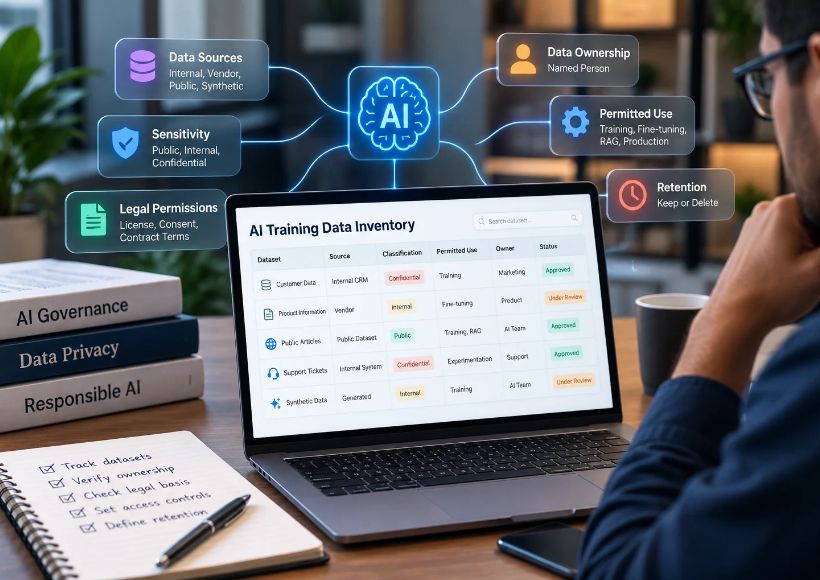
An inventory of AI training data is a document containing a listing of all datasets for training, testing, fine-tuning or retrieval of AI systems that a company uses, or plans to use. Each dataset entry contains information about its origin, ownership, sensitivity, purpose for use, and the legal grounds for usage.
What to record for each dataset
| Field | What to write | Why it matters |
| Dataset name and version | Name, version, date created | Lets you trace a model back to the exact data |
| Source and location | Internal system, vendor, public dataset, scrape, synthetic, plus where it is stored | Shows where the data came from and where it lives |
| Data owner | A named person, not a team | Someone is accountable |
| Sensitivity classification | Public, internal, confidential, personal data | Decides who can see, use or export it |
| Permitted use | Training, fine-tuning, retrieval (RAG) or automated actions; experimentation or production | Data that is fine for a test may not be approved for production |
| Legal basis, license and permission | Lawful basis for personal data, plus contract terms, license or consent | Personal data needs a lawful basis in addition to any copyright or contractual permission |
| Access constraints | Who and what systems may read it | Keeps AI workflows from reaching data they were never approved to use |
| Origin | Human-created, synthetic or mixed | Synthetic data can still raise privacy, confidentiality or IP issues if generated from real data |
| Quality notes | Completeness, duplicates, labeling accuracy, known gaps | Errors in the data carry straight into the model |
| Preparation steps | Cleaning, filtering, anonymizing | Anonymized data can still be re-identified |
| Retention and deletion | Retention period, deletion method | Defines when the data must go |
| Removal and rights handling | Whether the data can be removed from a model, retrieval index or vendor system, and how requests are logged | People may have rights of access, erasure, restriction and objection over personal data used in training |
| Vendor terms | Deletion and breach-notification terms in processing agreements | Your data is only as controlled as your weakest vendor |
| Approver and review dates | Who signed off, plus the date of the last privacy or legal review | Audit trail |
Retrieval data counts too. Vector databases sit in the data layer of AI infrastructure, and the datasets that feed them belong in the inventory.
Who is responsible for what
Data owner: confirms the record is accurate.
Business approver: decides whether the data can be used or shared.
Privacy or legal reviewer: checks personal data, lawful basis and licensing.
AI governance lead: keeps the inventory current.
Export access is not approval. Access controls should be kept separate from use and sharing approvals, so the person who can pull the data isn’t the only one deciding whether it leaves. Before any dataset leaves the company, list exactly what is being sent in an AI data export manifest, and check it against this inventory.
A record of an inventory that does not account for ownership, permitted use, or access restrictions is essentially an exercise in documentation rather than record keeping. The objective is to make a proper decision regarding the data before it is processed by an AI system.
What the rules expect
UK ICO: The rights of individuals in connection with personal data apply wherever generative AI is used in data processing: as training data, fine-tuning data, model output or user input. Data obtained for one purpose cannot be used for training generative AI unless the use is compatible. Organizations have to ensure that. Controllers are responsible for fulfilling these rights, and these responsibilities follow them through the whole AI lifecycle and supply chain. That is why the table contains retention, removal and vendor fields.
HITRUST: Its AI requirement says the AI data inventory should contain at least provenance and sensitivity level, and be reviewed and updated at least twice a year.
ISO/IEC 42001: According to Annex A.4.3 the identification and documentation of data resources used by the AI systems to run and manage are required. The data preparation and its provenance are dealt with in different data control clauses and requirements of the standard.
ISO/IEC 27001: Controls A.5.9 (information asset inventory) and A.5.12 (information asset classification) are general inventory and classification controls that serve as the basis for this concept.
Review inventory sooner than scheduled when any change is made to dataset, added to another use, or a new customer or vendor requests access.
What goes wrong without one (illustrative risks)
These come from practitioner reports, not regulatory findings.
Finding out that an artificial intelligence program created in another part of the company looks at customer information happens incidentally, as the program is not mentioned in the inventory.
A company receives an unsolicited proposal that gives access to data or codes; a way to assess the desirability of the proposal is missing.
A database has personal data that is overlooked, thus making it impossible to reply to a request for deletion or objection.
Common mistakes
- Listing a team as the owner instead of a person
- Recording the source but not the legal basis or permission
- Leaving out data used for retrieval
- Recording no deletion or removal path
- Updating the inventory once and never again
- Treating anonymized or synthetic data as automatically safe
