
25 Best Kitchen Gadgets That Make Cooking Easier
Last Updated on August 21, 2026 by chada sravas
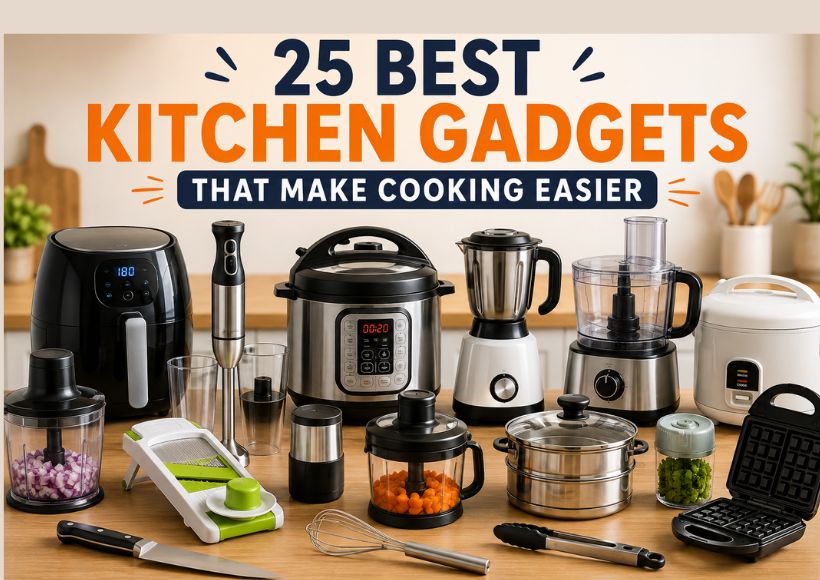
The best kitchen gadgets are the ones that take the repetitive work out of meals you already cook. In an Indian kitchen, that can mean pressure-cooking dal instead of simmering it for a long time, grinding coconut and spices without a stone grinder, chopping several onions at once, or preparing dosa batter in a machine designed for the job.
A useful gadget should also justify its space. An appliance that saves a few seconds but takes several minutes to assemble and clean may not improve your routine. On the other hand, a pressure cooker, mixer grinder, or food processor can remove a substantial amount of repetitive work when used regularly.
If you are also exploring useful gadgets beyond the kitchen, our guide to Cool Gadgets You Should Know About covers practical devices designed to make everyday tasks easier.
The 25 tools below are therefore weighted toward actual cooking frequency, preparation effort, cleanup, storage, and versatility rather than novelty.
1. Pressure Cooker: The Everyday Time Saver
For many Indian meals, the pressure cooker is still difficult to beat for practical time savings. Dal, rajma, chana, potatoes, and meat are all examples where pressure cooking can substantially shorten the cooking time compared with an uncovered pot.
The bigger benefit is that it reduces active cooking time. Once the food is safely cooking under pressure, attention can move to chopping vegetables, preparing tadka or making chapati dough.
A pressure cooker can also make batch preparation easier. Cooking a larger quantity of dal or beans once and using it for multiple meals can reduce the need for repeated preparation during a busy week.
Scenario highlight
Let’s consider preparing rajma. Normally, a big-time consumer in the dish is not chopping onions or tomatoes, but the process of cooking the beans. Using a pressure cooker helps solve this problem.
For home cooks in India who prepare dal, beans, rice or meat in daily life, the pressure cooker is one of the greatest innovations in the kitchen.
Where it has limits
Pressure cookers need careful use and ideal cooking times. However, pressure cookers cannot replace all cookware pieces at home. Foods that require browning, reduction, or constant checking must be cooked on the stovetop.
Quick buying checklist
- Choose a capacity appropriate for your household rather than automatically buying the largest model.
- Check the quality and availability of replacement sealing components.
- Consider whether stacking vessels inside the cooker would be useful for your cooking style.
- Prioritize established safety mechanisms over decorative features.
2. Mixer Grinder: The Indian Kitchen Workhorse
A mixer grinder earns its importance by doing the same jobs over and over again.
It might be busy with coconut chutney one day and making masala paste on another. Ginger and garlic paste, dry spices, and other similar tasks can also be done. This explains why Indian cooking involves so much grinding.
The source discussion described the Mixer as indispensable in some households, used almost every day, sometimes multiple times a day.
A practical distinction: wet vs. dry grinding
Grinding of dry spices and preparing a wet coconut chutney are two different processes. A small jar meant for dry spices is ideal for dry grinding, while a larger jar is better for wet grinding.
However, if you make idli or dosa batter daily, using an ordinary mixer grinder to grind large quantities may not be a long-term solution.
When it’s worth the counter space: households that frequently make chutney, masala, coconut paste, ginger-garlic paste or similar preparations.
Trade-off: multiple jars increase versatility but also mean more parts to wash and store.
3. Food Processor: When Preparation Happens in Bulk
A food processor is useful when the quantity is too large for hand preparation.
Think about preparing the vegetables for a big family gathering. Slicing a single potato is easy, but slicing several potatoes, grating carrots, shredding cabbage and chopping and preparing all vegetables is where the usefulness of the processor begins.
This gadget comes with attachments that enhance its functionality. The source mentions slicing, grating, making hummus, falafel, dal vada, and chilla batter, among other uses.
Scenario highlight: Tomatoes are different from onions
Just because a food processor is available does not mean it will work well with every type of food. For example, processing tomatoes for a little bit too long can turn them into distinct lumps in a pureed, watery mess. It is better to use short pulses when making a thick gravy base than to run the processing machine for longer.
The cleanup question
This is one of the most legitimate objections to food processors. Users in the supplied discussion specifically noted that they sometimes prefer a knife because they dislike assembling and cleaning the processor.
Food Processor vs. Electric Chopper
| Task | Food Processor | Electric Chopper |
| Small onion quantity | More equipment than necessary | Better suited |
| Large vegetable batch | Excellent | Limited |
| Slicing/shredding | Strong advantage | Usually limited |
| Small countertop footprint | No | Yes |
| Cleanup | More involved | Usually simpler |
| Batch cooking | Excellent | Moderate |
4. Electric Vegetable Chopper: Fast Prep Without a Full Processor
A chopper is a hybrid device that falls between a knife and a full-fledged food processor. It would be most useful when there are many ingredients to chop, which would otherwise be cumbersome to chop. A few onions for gravy, heaps of garlic for curry preparation, or an assemblage of ginger and herbs can be thus processed rapidly.
An important factor is the pulse function. When a device is running continuously, minced foods will quickly turn to mush; if that is beneficial for ginger and garlic, this is not what is wanted when visible pieces of onion are required.
Importance of capacity features. A small bowl may appear user-friendly in product pictures; however, you have to make multiple batches to prepare your dish.
Worth considering when
- You regularly chop onions, garlic, ginger or herbs.
- You want something simpler than a food processor.
- You have limited cabinet or counter space.
The trade-off is that it won’t replace a processor for slicing, shredding or larger quantities.
5. Rice Cooker: Let the Rice Take Care of Itself
Although rice is a very simple dish to make, cooking it on a traditional stove requires dedication.
However, a rice cooker takes that burden off your shoulders by automatically handling the cooking while you prepare the other items for the meal. The Indian home cook group has highlighted this advantage, noting the ease of switching it on and continuing with other cooking tasks.
This function is even more useful when there is already a pressure cooker and a kadai on the stove.
Pro
- Low active supervision
- Consistent everyday rice preparation
- Frees a stove burner
Con
Adds another appliance when a pressure cooker may already handle rice adequately
For a household that eats rice almost every day, that convenience can justify the additional appliance. For occasional rice eaters, probably not.
6. Air Fryer: Less Hands-On Cooking
An air fryer is useful for foods that normally require pan attention or a larger oven.
Vegetables, snacks, reheated foods and smaller roasted portions are common examples. Once food is placed inside, there is generally less active handling than pan-frying.
The supplied discussion also noted that an air fryer can reduce reliance on a conventional oven and make cooking easier for people who want less lifting or bending.
The capacity problem
A small air fryer can be excellent for one or two portions and frustrating for a family. If you need three batches to cook everyone’s food, some of the time-saving advantage disappears.
Buy based on how much you normally cook, not on the compact footprint alone.
Everyday Cutting Tools
Since appliances such as air fryers, mixer grinders and food processors are used frequently, proper cleaning and maintenance can help keep them working reliably. For more practical maintenance advice, see our guide on How to Keep Your Appliances Running Smoothly Longer.
7. Chef’s Knife
The right chef’s knife can save one hour of work in the kitchen each day.
A dull knife makes seemingly easy tasks like chopping onions, cutting veggies, and mincing herbs feel tedious rather than easy.
The discussion centred on knife types and on sharpening being a good investment.
The key is not buying the heaviest or most expensive knife. It should feel comfortable and balanced in your hand and be maintained properly.
8. Mandoline Slicer
When a recipe calls for a large quantity of thin, uniform vegetables, a mandoline can save substantial cutting time.
Potatoes for frying, cucumber for salad and carrots for quick slicing are obvious examples. The uniform thickness can also help food cook more evenly.
But the blade deserves respect. The discussion included warnings about finger injuries, and those concerns are legitimate.
Never trade safety for speed. Use the hand guard and stop using the slicer when the remaining piece becomes too small to hold safely.
9. Vegetable Peeler
Although a peeler is a small tool, it is one of those kitchen tools that can be used many times with little effort and maintenance.
An effective blade should glide through the skins of potatoes or carrots without requiring multiple passes. This means less time spent on preparation and less food wasted.
Since it takes up almost no space, it is easier to justify the purchase of a good peeler than many specialized machines.
10. Kitchen Shears
Kitchen scissors can perform small cutting tasks without a cutting board.
They come in handy for cutting herbs, spring onions, packaging materials and other activities that do not merit pulling out a knife. The text discussed kitchen scissors as a rather underrated tool.
When choosing kitchen scissors, look for ones with detachable joints. Small pieces of food can get caught in the hinge, and detachable scissors would make cleaning easier.
Appliances for Hands-Off Cooking
Some gadgets save time by allowing two cooking processes to run at once.
11. Steamer or Idli Cooker
The utility of a steamer is maximized if you use it often.
An idli maker requires a specific type of steamer, while larger steamers are good for steaming multiple types of vegetables and foods. Having several tiers increases capacity without taking up another burner.
The source mentions that a steamer-idli cooker combo is widely used to cook veggies and other foods.
The experience is greatly enhanced if you eat idlis, steamed vegetables, and the like regularly.
12. Immersion Blender
The immersion mixer is good for one function: mixing food without removing it from its pot.
When making soup, stew, sauce, and soft vegetables, it saves one from spilling things around and washing extra dishes.
The mixing process takes place in the cooking vessel, without transferring hot liquid to a standing blender.
Best advantage: fewer transfers and fewer dishes.
Limitation: It is not a replacement for a mixer grinder when you need to grind dry spices or make a fine coconut chutney.
13. Wet Grinder
For households that regularly prepare idli or dosa batter, a wet grinder serves a different purpose from a normal mixer grinder.
The source discussion noted that repeatedly making idli/dosa batter in a mixer grinder can wear out the machine and suggested using a wet grinder for regular preparation.
Wet Grinder vs. Heavy-Duty Mixer Grinder
| If your priority is… | Better fit |
| Regular idli/dosa batter | Wet grinder |
| Chutney and masala | Mixer grinder |
| Small wet preparations | Mixer grinder |
| Large batter batches | Wet grinder |
| Compact storage | Mixer grinder |
A wet grinder is therefore not a better mixer grinder. It is a better solution for a particular recurring task.
14. Electric Kettle
An electric kettle is a small time-saver, and it’s quite helpful when you frequently need boiled water.
It is a great help when you want hot water while cooking lentils, vegetables, or something else on the stove. It is a great advantage to have boiling water on hand when you need it to prepare tea, coffee, or food.
The only limitation is that it is not a very good item to have if there are almost no occasions when boiling water is needed beyond what you cook on a stovetop.
15. Slow Cooker
A slow cooker suits recipes where cooking time is long but active supervision is unnecessary.
It can be useful for dishes that benefit from extended cooking, especially when you want to start the food and focus on something else.
But in the case of Indian cuisine, a slow cooker is a more advanced purchase than a pressure cooker. In many households, cooking quickly is favoured over cooking for longer periods.
Hence, slow cookers are considered more of a device suited to specific lifestyles than just something bought for the home.
Baking and Mixing
16. Stand Mixer
A stand mixer helps eliminate the repetitive kneading involved in making bread, pizza, and other baked goods if you make them often.
In the discussion above, it was explicitly mentioned that a stand mixer should be used for dough making, bread baking, and pizza preparation.
The most compelling argument in favour of one device is not speed alone, but rather the device’s ability to handle repetitive tasks. At the same time, a person can focus on preparing something else.
One drawback is the device’s size. Be sure to measure your counter or cupboard space before you purchase a device that will be hard to reach and therefore not often used.
17. Electric Whisk
An electric whisk allows users to enjoy the benefits of electric mixing without the bulk of a stand mixer.
It functions well for beating eggs, whipping cream, and mixing less viscous batter. The source review revealed how useful electric egg whiskers are for everyday baking.
The small size of an electric whisk makes it a more sensible option for someone who only bakes occasionally than a regular stand mixer.
Small Tools That Earn Their Place
18. Manual Vegetable Dicer
A manual dicer can produce consistent pieces quickly, particularly for firm vegetables such as onions and peppers.
However, this category has mixed user feedback. Some people appreciate the speed, while others find the mechanism difficult to press or clean.
The important buying consideration is therefore not simply “does it dice?” but how much effort it requires and how easily the cutting grid comes apart for cleaning.
19. Garlic Press
A garlic press is useful when you need small quantities of crushed garlic repeatedly.
The convenience disappears if the press leaves a large amount of garlic trapped behind the holes or requires extensive cleaning afterward. For cooks who already make ginger-garlic paste in a mixer grinder, it may be unnecessary.
This is a classic small convenience tool rather than a kitchen essential.
20. Kitchen Tongs
Tongs can be used to flip veggies, pick up food, dish out salads, and handle hot food.
Longer tongs are beneficial because they keep the cook at a safe distance from hot foods, whereas shorter tongs allow the cook to regulate the food being picked more clearly. Tongs are also quite compact storage-wise.
Unlike many specialized kitchen tools, tongs are versatile and can be used in many different types of cooking.
21. Digital Kitchen Scale
A kitchen scale is most useful if consistency is paramount.
It is particularly valuable for baking, portioning ingredients, and following recipes that may not be uniform in their volume measurements.
The discussion identifies kitchen scales as practical tools, with the caveat that their usefulness depends on the individual chef.
It may not save enough time if you hardly bake or measure your ingredients precisely, since it takes up space in a drawer.
22. Citrus Juicer
A handheld juicer is a great tool for extracting juice from citrus fruits like lemons and limes without much effort.
It is also great for making drinks, sauces and other delicious food that contain fresh lemon juice. The main advantage here is that this tool will not save you much time in cooking, but will instead keep your work clean.
When using a juicer occasionally, you should use your hands since they seem faster, but when squeezing dozens of lemons, the tool becomes more valuable.
Tools for Batch Cooking
23. Freezer Portion Trays
One of the best strategies to cut down on cooking time is to prep your meals in advance.
Freezer portion trays help with this by allowing you to freeze soups, sauces, stock, and dishes in single servings instead of freezing one big pot and then thawing it.
The supplied discussion described this exact approach: cooking when there is more time or energy and reheating portions on busier days.
This is less glamorous than buying a new appliance, but it can save time across several meals.
24. Vacuum Sealer
A vacuum sealer is most useful when batch cooking and freezer storage are already part of your routine.
It can package ingredients or prepared food into portions for later use. That can make a planned freezer inventory easier to manage and reduce the need for repeated preparation.
However, it is not advisable to purchase a vacuum sealer solely for the convenience of vacuum sealing. Vacuum sealers require storage, as well as bags or rolls that need to be purchased consistently.
Ideal for: people who frequently prepare meals in advance or users of freezers who regularly portion their meals ahead of time.
25. Anti-Fatigue Kitchen Mat
While kitchen mats do not reduce cooking time, they do help reduce fatigue during long cooking hours. This is important for those who spend a lot of time preparing meals at the stove, sink, or kitchen counters. Several suggestions concerning cushioned anti-fatigue mats have emerged in this context.
When you are buying a kitchen mat, don’t be deceived by mere looks. Just because a mat looks artistic or beautiful does not mean it is an anti-fatigue mat. What is important is that the kitchen mat has good cushioning, stability, and easy cleaning.
Kitchen gadgets are only one part of an efficient cooking setup. If you’re also planning to upgrade your main cooking appliance, see our guide to buying an online gas stove, which covers convenience, efficiency and important factors to consider before purchasing.
Which Kitchen Gadget Should You Buy First?
The response relies on where your cooking time vanishes.
If you are having trouble with prep work, start with a stand mixer, an electric chopper, a food processor, or a good knife. If monitoring food cooking is the actual challenge, a pressure cooker, rice cooker or an air fryer, for instance, may be more useful than something else. For someone who cooks idli or dosa batter regularly at home, a wet grinder may be more valuable than any other kitchen appliance.
| Your biggest kitchen problem | Start with |
| Dal, beans or meat take too long | Pressure cooker |
| Chopping onions and vegetables | Electric chopper |
| Large-batch vegetable preparation | Food processor |
| Chutney and masala preparation | Mixer grinder |
| Daily rice cooking | Rice cooker |
| Snacks and roasting with less attention | Air fryer |
| Soups, dal and purees | Immersion blender |
| Idli/dosa batter | Wet grinder |
| Baking and dough | Stand mixer |
| Batch meal preparation | Freezer portion trays |
Consider the frequency of use, cleaning, and storage before you invest in one of these kitchen appliances. A great food processor that cuts down prep time, but has too many pieces to clean after each use, can sit in the cupboard. The same goes for a big machine that has no reliable place to be kept in the kitchen.
Usually, the item you’ll use most is the best buy – not the one with more features.
Final Thoughts
The necessary kitchen gadgets must facilitate cooking rather than further complicate the process.
Some of the most effective time-saving devices in Indian kitchens are the pressure cooker, mixer grinder, food processor, electric chopper, rice cooker, air fryer, and wet grinder, when used with relevant cooking practices. Of course, the simplest ones, like a knife, peeler, shears, and tongs, may be less fancy but are used regularly and can bring great benefits.
The ultimate challenge is clear: does this device eliminate a tedious job you no longer want to do?
Provided it is efficient at performing such activities and easy to maintain and store, it is very likely to make its way into your daily cooking routine. On the other hand, if it performs a job that has to be done in a while, it might be better to keep the kitchen counter empty.
