
Google AdSense: Complete Guide to Approval & Revenue (2026)
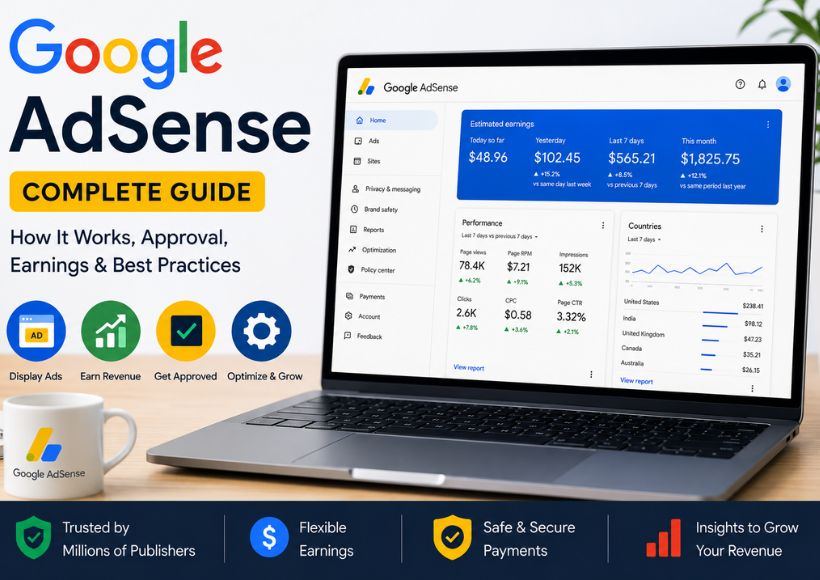
For many website owners, Google AdSense is the first step toward turning content into income. Yet most articles about AdSense begin with the same definition: “Google AdSense is an advertising program that lets publishers earn money by displaying ads.” While that’s technically correct, it doesn’t explain why some websites consistently grow their earnings while others struggle to receive approval or generate meaningful revenue.
The reality is that Google AdSense has evolved alongside Google’s search ecosystem. A decade ago, simply adding ad code to a website with decent traffic was often enough to earn a steady income. Today, the landscape is different. Search algorithms prioritize helpful content, users expect faster and more trustworthy websites, and advertisers want their brands to appear alongside reliable information. As a result, AdSense has become closely connected to content quality rather than just website traffic.
Many beginners spend weeks searching for questions like “How many articles do I need for AdSense?” or “How much traffic is required for approval?” Surprisingly, Google doesn’t provide official numbers for either. That’s because approval isn’t based on reaching a specific milestone. Instead, Google evaluates whether your website provides genuine value, follows program policies, and creates a positive experience for visitors.
Understanding this shift is more important than memorizing another approval checklist. Publishers who focus only on getting approved often stop improving once ads begin appearing. Successful publishers take a different approach. They build websites that readers trust first, knowing that sustainable advertising revenue follows naturally when users continue returning for useful information.
Google AdSense Is More Than an Advertising Platform
Most people think of AdSense as a tool that places advertisements on a website. In reality, it represents a partnership between three participants: advertisers who want visibility, publishers who create valuable content, and Google, which connects the two.
Advertisers don’t pay simply because a website exists. They invest because they expect their advertisements to appear where people are genuinely engaged. This explains why Google places significant emphasis on website quality. A visitor who spends several minutes reading a detailed article is far more valuable to advertisers than someone who lands on a thin page and leaves immediately.
This perspective changes how publishers should think about monetization. Instead of asking, “Where should I place my ads?” a better question is, “Why would someone spend time on my website?” If the answer is clear, advertising becomes a natural extension of the user experience rather than the primary purpose of the website.
Why Many New Publishers Misunderstand AdSense
One of the biggest misconceptions surrounding AdSense is that approval depends on a secret formula. Online discussions often recommend publishing a certain number of articles, waiting several months, or reaching a specific traffic threshold before applying. These suggestions are based on personal experiences rather than official requirements.
Google’s documentation focuses on something much broader: original content, policy compliance, and a website that provides value to users. Two websites with the same number of articles can receive completely different decisions because Google’s evaluation goes beyond quantity.
Imagine two technology blogs.
The first publishes fifty short articles explaining basic definitions that already exist on hundreds of other websites. Each page answers a question but offers little additional insight.
The second publishes twenty carefully researched articles. Every guide includes original screenshots, practical examples, comparisons, and explanations that help readers solve real problems.
Although the second website contains fewer articles, it contributes more value to the web. That’s the difference Google aims to identify.
How Google AdSense Actually Works Behind the Scenes
When someone visits your website, the advertisements they see aren’t randomly selected. Google’s advertising systems analyze several signals within milliseconds to determine which advertisements are most relevant to both the visitor and the content on the page.
This process considers factors such as the article’s topic, Most advertisements delivered through Google AdSense belong to the broader category of display advertising. These ads may appear as banners, responsive image ads, rich media creatives, or text advertisements depending on the advertiser’s campaign and the available placement. Understanding the difference between banner advertising and other forms of online advertising helps publishers optimize their layouts without compromising user experience.
For publishers, this means earnings depend on much more than traffic alone. A website attracting highly engaged visitors interested in competitive industries may generate significantly higher revenue than another website receiving more page views but attracting less valuable advertising demand.
Understanding this relationship helps explain why experienced publishers spend more time improving content quality and audience engagement than chasing short-term traffic spikes.
The Biggest Mistake New Publishers Make
Many new bloggers believe that monetization should begin as quickly as possible. As soon as a website launches, they search for approval checklists, advertising placements, and expected monthly earnings.
This approach often produces the opposite result.
Readers don’t return because a website displays advertisements. They return because the content consistently answers their questions better than competing websites. Google recognizes this pattern through user satisfaction signals, content quality, and long-term website performance.
Successful publishers usually follow a different order.
They first build authority within a specific niche, publish useful resources, improve website navigation, and establish trust with readers. Only after creating a strong foundation does advertising become a meaningful source of income.
In other words, AdSense should reward a valuable website—it shouldn’t be the reason the website exists.
Why Some Websites Earn 10 Times More Than Others
One of the biggest surprises for new publishers is discovering that two websites with similar traffic can generate completely different AdSense revenue. Many assume Google pays based only on page views, but that’s only one piece of the puzzle.
Advertising works like an auction. Every time a visitor opens your page, advertisers compete for that advertising space. The winning bid depends on factors such as the industry, advertiser competition, visitor location, device, and even the user’s likelihood of engaging with an advertisement.
For example, a website covering cloud computing, cybersecurity, enterprise software, or financial services often attracts advertisers willing to pay more because acquiring a customer in those industries is expensive. In contrast, websites focused on jokes, wallpapers, or viral entertainment usually receive lower bids because advertisers expect lower conversion rates.
This doesn’t mean you should chase high-paying keywords simply for revenue. A website that publishes random finance articles despite having no expertise may struggle to build trust with readers. Google’s quality systems increasingly reward topical authority, meaning publishers who consistently create valuable content within a niche often perform better in both search rankings and advertising revenue over time.
The lesson is simple: sustainable AdSense income is built on audience trust, not just traffic numbers.
The Relationship Between SEO and AdSense
Many beginners think SEO and AdSense are separate topics. In reality, they influence each other more than most people realize.
Many beginners think SEO and AdSense are separate topics. In reality, they influence each other more than most people realize. While AdSense helps publishers monetize their websites, advertisers typically reach those same audiences through PPC advertising, where they pay to display ads in search results or across Google’s Display Network. Understanding how both models work provides a clearer picture of Google’s advertising ecosystem
SEO helps people discover your content through search engines. AdSense monetizes that attention. If your SEO strategy attracts visitors who quickly leave because the content fails to meet their expectations, both rankings and advertising performance can suffer.
This is why experienced publishers don’t optimize articles only for keywords. They focus on search intent. When someone searches for “How to fix Crawled – Currently Not Indexed,” they expect practical solutions, screenshots, and explanations—not a rewritten definition from Google’s documentation.
Content that genuinely satisfies search intent naturally increases engagement, encourages sharing, and earns backlinks. Those signals improve search visibility, which in turn creates more opportunities for AdSense revenue. In other words, AdSense is not an alternative to SEO; it is one outcome of a successful SEO strategy.
Should You Use AI to Create AdSense Content?
Artificial intelligence has changed content creation dramatically, but it has also created one of the biggest misconceptions in digital publishing.
Some believe Google rejects AI-generated content automatically. Others assume AI can replace research and expertise entirely. Neither view reflects Google’s published guidance.
Google evaluates the usefulness of the final content rather than the tool used to create it. AI can help organize ideas, summarize research, or improve writing efficiency. Problems arise when publishers generate dozens of articles without fact-checking, editing, or adding original insight. The result is often content that looks polished but offers little new information.
Think of AI as a junior research assistant rather than the author. It can save time, but your experience, analysis, examples, and judgment are what make an article valuable. Readers rarely remember perfectly formatted sentences; they remember learning something they didn’t know before.
Common Mistakes That Reduce AdSense Revenue
Many publishers focus on increasing advertisements instead of improving the overall experience of their website. Ironically, this approach can reduce long-term earnings.
Some of the most common mistakes include:
- Filling pages with advertisements before building reader trust.
- Publishing dozens of similar articles targeting slight keyword variations.
- Ignoring page speed and mobile usability.
- Writing for search engines instead of answering readers’ questions.
- Depending entirely on AdSense instead of diversifying income.
Successful publishers usually follow a different philosophy. They invest in creating content that attracts loyal readers first. Advertising becomes more effective because users stay longer, explore additional pages, and return for future content.
AdSense Should Be Part of a Bigger Strategy
Many new bloggers celebrate their first AdSense approval as if they have reached the finish line. In reality, approval is only the beginning.
The most successful websites rarely depend on a single source of income. As they grow, publishers often combine AdSense with affiliate marketing, sponsored content, digital products, online courses, newsletters, consulting services, or premium memberships.
Diversification creates stability. Advertising rates fluctuate throughout the year, and search traffic changes with algorithm updates. Websites that rely on multiple revenue streams are generally more resilient because they are not dependent on one platform or one source of traffic.
AdSense works best as part of a long-term publishing strategy rather than the entire business model.
The Future of Google AdSense
Search is evolving rapidly with AI-generated answers, conversational search experiences, and changing user behavior. Many publishers worry that these changes will reduce advertising opportunities.
While search continues to evolve, one principle remains consistent: people still seek trustworthy information when making important decisions. Whether someone is choosing financial software, troubleshooting a technical issue, or researching a product, they often want detailed explanations that AI summaries cannot fully replace.
This creates an opportunity for publishers willing to invest in expertise, original research, and practical experience. Instead of competing to publish faster, successful websites are likely to compete by publishing deeper, more reliable content that readers trust.
The future of AdSense belongs less to websites with the highest number of articles and more to those that consistently provide information worth reading.
Final Thoughts
Google AdSense is often presented as a simple advertising platform, but its success depends on something much more important: the quality of your website. Publishers who treat AdSense as a shortcut to earning money frequently become discouraged when approvals or revenue fall short of expectations. Those who focus on helping readers, building authority within a niche, and creating genuinely useful content usually discover that advertising revenue grows naturally alongside their audience.
Instead of asking, “How can I earn more from AdSense?” consider asking a different question:
“What can I publish today that readers won’t find anywhere else?”
The answer to that question will improve not only your AdSense performance but also your SEO, brand reputation, and long-term growth as a publisher.
