
What Is Machine Learning? Explained Simply with Real Examples
Last Updated on May 9, 2026 by chada sravas
Picture when the last movie or show you liked on Netflix, for instance. Perhaps you can recall multiple occasions when Google Maps guided you to the quickest route before you even realized traffic was backed up. All of these occurrences are happening because of machine learning operating behind the scenes.
Machine learning does not exist as an abstract idea. This technology has already begun to influence users’ habitual decisions without their knowledge.
What is Machine Learning
Machine learning enables computers to learn from data rather than being programmed to perform a specific task.
When you use traditional programming, you provide the computer with instructions in the form of code that tell the computer exactly how to do something. However, with machine learning, you provide the computer with examples of what you want it to do, so that, through trial and error, it can learn to create patterns that enable it to complete the tasks you require of it.
You can think about how you would teach a kid as an analogy for teaching a machine. For instance, if you tell the child to learn to identify apples and bananas, you cannot give the child all the rules. You would have them identify examples many times by saying, “This is an apple,” then “This is a banana.” Eventually, the child will correctly identify either the apple or the banana. This is very similar to how machines learn.
How Machine Learning Actually Works
The process that takes place behind the screen isn’t magic; there’s an established order to it.
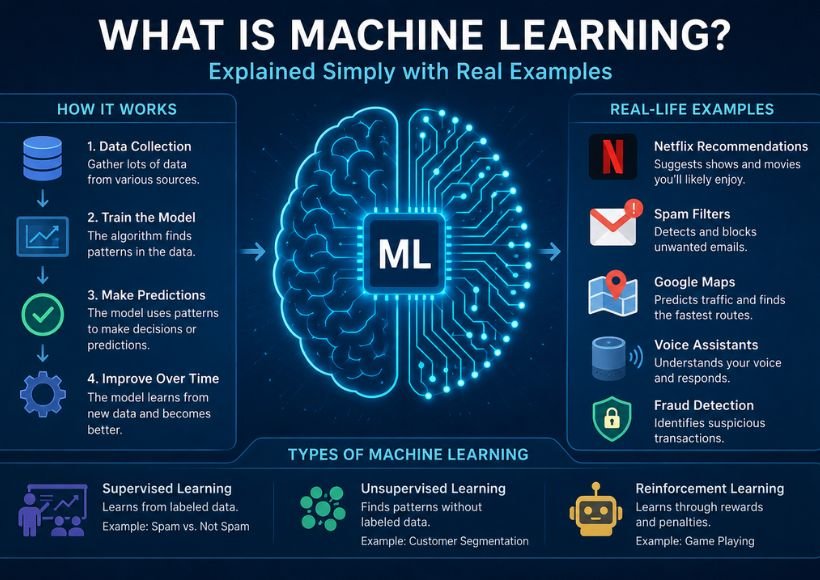
The first step is to create an input of many sets of input data. The data can include anything, such as pictures, information, numbers, or activities performed by an online user.
Next, a computer program, an algorithm, examines this set of input data and begins looking for patterns. The algorithm will modify itself as often as possible to find a more reliable perspective.
The process of improving predictive ability over time results in a trained system capable of making better predictions. Many modern AI systems also depend on cloud computing learning paths because machine learning models require scalable computing power and infrastructure.
After successfully training the system, the model can be used to make actual predictions and decisions based on real-world examples (e.g., classifying email as spam or identifying products you are likely to purchase).
It is important to understand that the machine is not given specific instructions on how to solve problems; instead, it learns by exploring, experiencing errors, and adapting.
Types of Machine Learning
There are different ways machines learn, but you don’t need to overcomplicate it.
Supervised learning: The system learns from labeled data (for example, spam vs. not spam).
Unsupervised learning: It finds patterns without predefined labels.
Reinforcement learning: It learns through rewards and penalties, similar to trial-and-error learning.
There are many machine learning methods, but all achieve the same goal: learning from data.
Real-Life Examples You Already Use
Machine learning is not theoretical. It’s already part of daily life:
- Recommendation systems on Netflix, YouTube, and Amazon
- Spam filters in your email
- Google Maps traffic predictions
- Voice assistants like Siri or Alexa
- Fraud detection in banking
These systems improve over time because they continuously learn from new data.
Why Machine Learning Matters
The real value of machine learning is not just automation—it’s better decision-making.
Businesses use it to understand customer behavior, predict trends, and improve services. Many modern systems used in artificial intelligence in the workplace rely heavily on machine learning to automate tasks and improve decision-making.In healthcare, it helps detect diseases earlier. In finance, it identifies suspicious transactions.
Instead of relying solely on human intuition, machine learning uses data to make faster, more accurate decisions.
Challenges You Should Know
Machine learning is powerful, but it’s not perfect.
The biggest issue is data quality. If the data is wrong or biased, the results will also be wrong. This is often summarized as “garbage in, garbage out.”
Another challenge is overfitting—when a model learns too specifically from training data and fails in real-world situations.
There’s also the problem of transparency. Some advanced models act like “black boxes,” meaning even developers can’t fully explain how they make decisions.
Understanding these limitations actually increases trust, because it shows the technology isn’t blindly perfect.
How to Start Learning Machine Learning
Many beginners will watch tutorial videos for hours until they run out of ideas to create projects from scratch, so they have no practical experience (stuck), which is where true learning ends.
Instead, a much better way to learn is to learn a new idea/concept and immediately practice using it.
Begin with the fundamentals, going from simple linear regression models and very basic neural networks. Students planning a long-term career in AI often start by understanding the basics of a data science degree before moving into advanced machine learning concepts.
You should work on just a single area of focus rather than trying to tackle AI, deep learning, LLMs, and other related tools simultaneously.
The key is to create small project-based experiences; even trial-and-error projects will give you a better understanding of how each component functions. Making mistakes is expected and will ultimately provide more learning opportunities than any theory you study.
Final Thoughts
Machine learning does not assume that machines suddenly gain intelligence, but rather focuses on creating systems that continue to improve over time through data.
This is important because it provides people with scalable solutions to otherwise complex problems. It helps us interact with technology through recommendations and predictions; therefore, we’re beginning to see the impact of machine learning every day.
When you grasp those concepts and go through hands-on experiences with them, machine learning becomes far less complicated; this is when things will really start falling into place for you.
