
A Day in the Life of a Social Media Manager at VIVANTINA
Last Updated on October 23, 2026 by chada sravas
You may envision a social media manager as the person spending eight hours a day scrolling through Facebook, Instagram, and TikTok, and while it is true that I do spend time in front of my computer and in any of the aforementioned apps, it is actually less than five percent of my job. The remainder of my day entails planning, writing, designing, managing communities, communicating with clients, and most importantly, analyzing data.
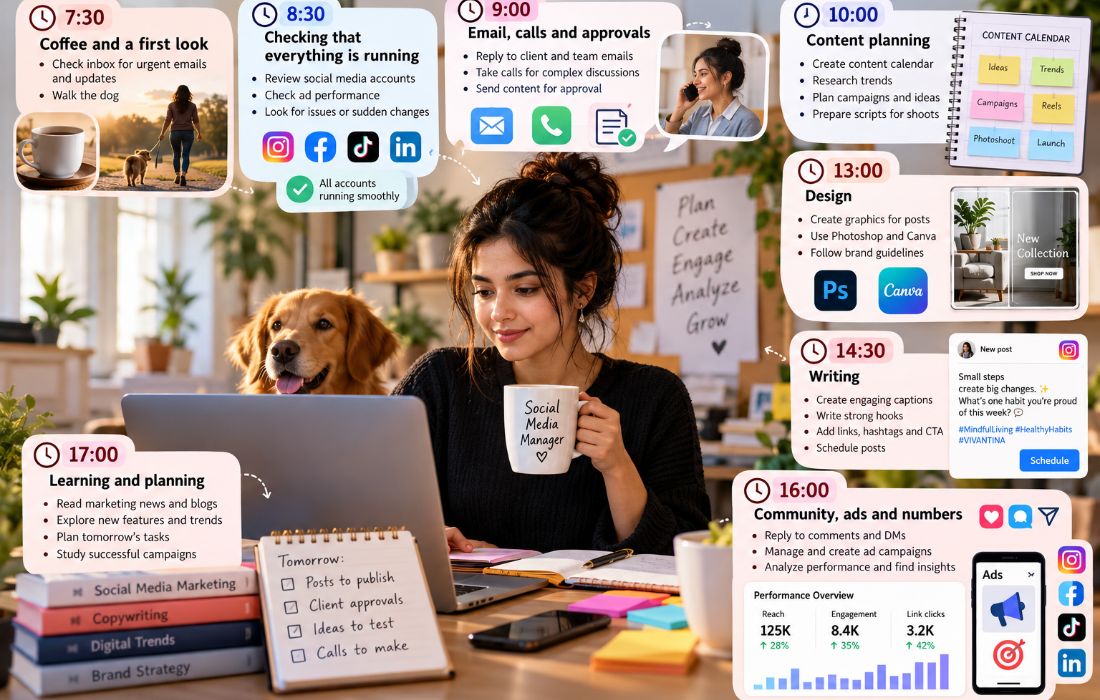
This is how my daily routine looks like at VIVANTINA, hour by hour, along with the programs I am using and things that go unnoticed.
7:30 – Coffee and a first look
The morning routine consists of having a cup of coffee and looking at the inbox. At this point, the emails are left unanswered but it is possible to see if there is anything urgent that requires my attention, for example, a complaint from a customer, a big issue that is commented on Social Media, or an approval needed by lunchtime.
Then I walk my dog. This may seem trivial but I think best when I am outdoors.
8:30 – Checking that everything is running
When I start reviewing emails, I first check the accounts of each client. The first step includes checking three things:
- Is everything working? This means that contents have been made in time, and no account has faced any technical difficulties.
- Are ads running smoothly? I check whether the advertising campaign is already delivering its outcome, whether any advertisement has been disapproved, and whether the expenditure corresponds with the initial plan.
- Does anything require attention? If there is a sudden drop in reach, an unexpected increase in comments, or something that performs better than expected a lot of attention is still needed.
This thirty-minute check has saved me from several awkward client calls. Ads need it most: a rejected ad, a delivery problem, unexpected spend or a sudden drop in performance all call for a fast response.
9:00 – Email, calls and approvals
Every day I get messages from colleagues and clients. Some share news about their company, some send material for upcoming posts, and some just ask how things are going.
I spend the necessary time on each email that comes my way, but there is one rule that I adhere to. If I sense that my reply to an email will be complicated enough to require several paragraphs, I decide to make a call instead. Spending several minutes on the phone saves me from writing lengthy emails, and at the same time gives my customers an opportunity to talk to me and have my support. My talk with customers allows me to know their needs better than their emails do.
This is also when I send content for approval. Clients see posts before they go live, so I keep a simple approval log to avoid confusion about which version is final.
10:00 – Deep work and content planning
It is my concentrated moment: any notifications are switched off. My responsibilities include creating the content calendar, researching trends, preparing screenplays for the photo shoots or video shootings, and creating other ideas for different campaigns. Planning is an essential part of my job: I have to prepare everything about posts that seem easy to publish in the feed few weeks before their publication.
13:00 – Design
Once I finish a fast lunch with my friends, it will be time for creative work. With Photoshop open (and sometimes even Canva for quick designs), I begin designing graphics for the posts I need to publish for the next day.
All brands have set visual rules; color palettes, fonts, spacing, and how photos are cropped. Following these guides in your work is what defines professionalism of appearance of your profile. In addition, I elaborate on composition of images based on their purpose: a square post, vertical story and a short video cover are not the same types of content.
14:30 – Writing
People tend to underestimate this aspect of copywriting as they think that writing a caption is a simple process. The truth is that the task of creating engaging content can be quite time-consuming.
My process looks like this:
- Start with the goal. Is the post meant to inform, entertain, drive traffic or start a conversation?
- Write for the audience, not the brand. What would make this person stop scrolling?
- Draft the hook first. The first line decides whether anyone reads the rest.
- Edit hard. I cut anything that does not earn its place, then read it aloud to check the tone.
- Check the details. Links, hashtags, tags, spelling and call to action.
Once the posts are finished, they go into the content calendar and I schedule them with the scheduling tool.
I choose posting times from each audience’s analytics, and I use general benchmarks like this guide to the best time to post on each platform as a starting point
16:00 – Community, ads and numbers
Following that, I actually spend some time on the social media platforms. I answer new comments and DMs, thank people for sharing their pleasant words, and respond to queries. If anything requires a professional answer, like anything regarding a product or a complaint, I submit it to my customer and confirm the response before making my statement.
I create new advertisements and boost advertising posts that have a good performance. Any advertisement campaign must have a definite goal, target audience, expenditure limit, and theme; furthermore, I always know how I am going to evaluate the campaign results in advance.
Then I look at the numbers. Depending on the client, I review:
- Reach and impressions → awareness
- Engagement rate (reactions, comments, shares, saves) → audience interest and how well the content resonates
- Link clicks → traffic to the website
- Leads, enquiries, sales or sign-ups → business impact
- Cost per result → advertising efficiency
- Follower growth → long-term audience building
I aim for larger figures only if they give me relevant insights. For me, every indicator is connected to a goal for the business, because I want to see what specifically boosts performance. The goal is to find out patterns, what topics and formats and at what times of the day I should post to achieve my goal next week.
A real example:
For one client, short videos with behind-the-scenes glimpses were always getting more saves and shares than sleek graphics of the product. Thus, we switched to doing two posts weekly in that format and started to see the rise of the engagement without any increase of the budget.
17:00 – Learning and planning
For the majority, the official working hours are completed here. However, for me, the last two hours of work are completely different. Social media evolves quickly, which means that algorithms change, new features arise, and formats used last year are no longer relevant. Due to this, I read marketing news, follow blogging activity, and read books about marketing. For now I have been getting aquainted with a book on copywriting that helps me improve my headlines, concentration, and comprehension of why people read certain things.
Then I open my notebook and plan tomorrow: what must be published, what needs approval, which ideas I want to test and which calls I need to make. Planning the next day before I stop means I start it calmly instead of in a rush.
I also study advertising campaigns to see why some stay in people’s minds for decades. check this advertising campaigns is a good example.
The part nobody warns you about
Social media is not limited by the conventional working hours. Customers can get in touch during night hours, posts might become popular during weekend, and issues can arise at any time. My phone is hardly out of reach, and it seems the same holds true for many people in this business.
As the time has passed by I have learned the importance of boundaries as I have already established decent terms of responses with clients in addition to being able to tell an emergency from a non-urgent issue. Moreover, I would recommend all newbies working in social media management to follow this example as burnout is a real risk in this industry.
Why I still love it
This job is hard work. It requires continuous learning and creativity. I am excited to have the freedom in this job, and I enjoy assisting businesses and people in getting noticed and building good rapport with the customers. The thrill of witnessing a small brand gaining clientele is enough for me to stay awake at night.
